The troops are the true American heroes, not star athletes, movie stars, or business tycoons. It's the men and women who put their lives on the line for the red, white and blue. But the case of U.S Army Sgt. Bowe Bergdahl has put that ideal on hold for the time being.
The White House, in an unprecedented move, essentially traded five extremely dangerous members of the Taliban for the safe recovery of Sgt. Bergdahl. We don't negotiate with terrorists, that's a hallmark of these United States. At no point do we ever stoop down to the level of radical members of terrorist groups and give them what they want. But this time we did, and what precedent is it setting? According to CNN correspondent Elise Labott, the Obama Administration says that no precedent has been set by this weeks actions.
To make matters worse, a litany of scandals has surrounded Sgt. Bergdahl which weren't anticipated by the Obama Administration. He has been accused of being a deserter. Leaving a note, and all of his belongings behind as he waltzed off base one night in 2009. Jake Tapper of CNN states that veterans claim his "selfish act ended up costing the lives of better men."At least six were killed in the search.
To make things worse, Tapper reports that soldiers in his battalion signed a "nondisclosure agreement... to never share any information" regarding Bergdahl. This doesn't sound an awful lot like the America we are used to. Soldiers are supposed to set the benchmark for humility, and be role models to their communities and country. And who really knows whether or not Bergdahl was conspiring with the Taliban? Nobody, speculation alone should be a red flag before executing such a risky trade.
Nobody is happy with the situation at hand. The world may indeed be worse off with the release of the "Cuban five," but what's done is done. Unfortunately though, this scandal has weakened the United States. We have compromised our morals for a person with no real way of backing up the circumstances of his disappearance. The public should be outraged. When we lose touch with our own values, (and yes, by we I mean the government in this case) who knows what can happen when put under a new kind of pressure situation... Only time will tell
Thursday, June 5, 2014

Wednesday, June 4, 2014
So... Who Actually Has the Greatest Fans?
After every major accomplishment by a player or team, the phrase, "we have the greatest fans in the world" is often thrown around as praise. But is this commonly uttered phrase thanking the fans for their loyalty? Or, rather, allowing the athletes to represent their city?
Unfortunate as it may be, the Chicago Blackhawks, our beloved hockey dynasty, lost game 7 at home to the Los Angeles Kings. But for a small moment, my fellow sports fanatics and I focused on an alarming statistic, which bashed the loyalty of the adversary's fan base. In fact, according to Bleacher Report, the losing Blackhawks reeled in five times the amount of viewers as our foes, who just happen to be in the nations number 2 TV market. "The game actually pulled a higher rating in Buffalo" according to the very same article.
Whether or not they had ample support from their fan base, the Kings are on their way to the Stanley Cup final, one of the most cherished prizes in sports. But it got me thinking, who really has the best fans, and why are they better in certain places compared to others?
Being loyal to a sports franchise can be hard, we all get that. It's difficult for some to want to attend a game which has a high probability of ending in defeat. But why don't we all take a look at the Chicago Cubs as an example. Their unprecedented streak of over 100 years without a championship tops all, but still, year in and year out they pull in the fans. They are one of the worst teams in baseball currently, and have been for the better part of two decades. But fans come for the experience, not necessarily the team. It's a far different culture going to a Cubs game than it is anywhere else. The culture of the city plays a big role in fan loyalty.
It also has to do with where you are, geographically speaking. In defense to the Kings, Hollywood doesn't strike us as a hockey town, after all it sits in perfect temperatures nearly every day of the year. People in warm climates are less likely to fall in love with a sport played on ice. Much like people are less likely to attend a baseball game if it's going to be 35 degrees outside.
Whether we like it or not, the most loyal fans are those to teams who constantly put up a winning record and compete for championships. That's what we crave, we want a celebration. It's a huge bummer when your team gets knocked out after years of hard work. Some franchises just know how to put a winning team in the spotlight.
Unfortunate as it may be, the Chicago Blackhawks, our beloved hockey dynasty, lost game 7 at home to the Los Angeles Kings. But for a small moment, my fellow sports fanatics and I focused on an alarming statistic, which bashed the loyalty of the adversary's fan base. In fact, according to Bleacher Report, the losing Blackhawks reeled in five times the amount of viewers as our foes, who just happen to be in the nations number 2 TV market. "The game actually pulled a higher rating in Buffalo" according to the very same article.
Whether or not they had ample support from their fan base, the Kings are on their way to the Stanley Cup final, one of the most cherished prizes in sports. But it got me thinking, who really has the best fans, and why are they better in certain places compared to others?
Being loyal to a sports franchise can be hard, we all get that. It's difficult for some to want to attend a game which has a high probability of ending in defeat. But why don't we all take a look at the Chicago Cubs as an example. Their unprecedented streak of over 100 years without a championship tops all, but still, year in and year out they pull in the fans. They are one of the worst teams in baseball currently, and have been for the better part of two decades. But fans come for the experience, not necessarily the team. It's a far different culture going to a Cubs game than it is anywhere else. The culture of the city plays a big role in fan loyalty.
It also has to do with where you are, geographically speaking. In defense to the Kings, Hollywood doesn't strike us as a hockey town, after all it sits in perfect temperatures nearly every day of the year. People in warm climates are less likely to fall in love with a sport played on ice. Much like people are less likely to attend a baseball game if it's going to be 35 degrees outside.
Whether we like it or not, the most loyal fans are those to teams who constantly put up a winning record and compete for championships. That's what we crave, we want a celebration. It's a huge bummer when your team gets knocked out after years of hard work. Some franchises just know how to put a winning team in the spotlight.
Monday, May 26, 2014
David and Goliath
What is the step in your life that really pushes you over the hump and helps you accomplish your dreams? Many business tycoons and politicians may say college, specifically their links to the elite private institutions, stemming all the way back into grade school perhaps. But how much does all of that really matter?
In a blog from one of my classmates, I read that, Phillips Academy, a private grade school in New Hampshire has stemmed "48 senators, governors, and representatives in its time" and it boasts a 30% ivy league yield rate. Institutions like this are only available to certain people, with tuition climbing well above $40,000 for each year.
Does enrollment in one of these private institutions guarantee success? Or, better yet, is it the key to success? Many think it holds an integral influence the success of a person, contrary to the American Dream, which is that anybody can succeed regardless of the privileges they have as a child. In a recent 60 Minutes segment, Canadian journalist and best-selling author Malcolm Gladwell talked about the underdog. His recent masterpiece, "David and Goliath," illustrates "the contrast between seemingly elite prep schools and more downscale ones in which students may be likelier to excel." His advice over the course of the segment, and the ultimate message of his book being, "ignore school ratings. Be a big fish in a small pond. Who wants to be a guppy at Harvard?"
Gladwell's book demonstrates an interesting point that many people shy away from. We all strive to go to the best universities possible so we have a better chance to succeed. But maybe the best idea is to go where you can excel, not necessarily where you may be just average. The argument he makes adds a glimmer of hope that the American Dream is still alive and well. That money doesn't necessarily lead to greater success. But self-analyzation and the ability to find an environment to thrive in does.
In a blog from one of my classmates, I read that, Phillips Academy, a private grade school in New Hampshire has stemmed "48 senators, governors, and representatives in its time" and it boasts a 30% ivy league yield rate. Institutions like this are only available to certain people, with tuition climbing well above $40,000 for each year.
Does enrollment in one of these private institutions guarantee success? Or, better yet, is it the key to success? Many think it holds an integral influence the success of a person, contrary to the American Dream, which is that anybody can succeed regardless of the privileges they have as a child. In a recent 60 Minutes segment, Canadian journalist and best-selling author Malcolm Gladwell talked about the underdog. His recent masterpiece, "David and Goliath," illustrates "the contrast between seemingly elite prep schools and more downscale ones in which students may be likelier to excel." His advice over the course of the segment, and the ultimate message of his book being, "ignore school ratings. Be a big fish in a small pond. Who wants to be a guppy at Harvard?"
Gladwell's book demonstrates an interesting point that many people shy away from. We all strive to go to the best universities possible so we have a better chance to succeed. But maybe the best idea is to go where you can excel, not necessarily where you may be just average. The argument he makes adds a glimmer of hope that the American Dream is still alive and well. That money doesn't necessarily lead to greater success. But self-analyzation and the ability to find an environment to thrive in does.
Sunday, May 11, 2014
Drafting Diversity
Michael Sam, the former Defensive End for the Missouri Tigers, is the first openly gay player to be selected in the NFL draft. Sam, whose draft stock plummeted due to lackluster performances in the NFL draft combine paired with his announcement in February, was selected in the 7th round with the 249th pick overall to the St. Louis Rams.
Whether or not the pick was out of confidence in his production on the field, or a PR stunt, will be determined late this summer, when NFL teams pick their final rosters. But regardless of the outcome, history has been made and it has been receiving national headlines. Even a statement from President Barack Obama congratulated Sam on beginning his next chapter, stating, "from the playing field to the corporate boardroom. LGBT Americans prove every day that you should be judged by what you do and not who you are."
But shouldn't the story be that the Rams are drafting a superior athletic talent rather than a token? It's undeniable that a huge step has been made to abolish intolerance. But not once since he was picked have I heard anything regarding his ability to tackle, his speed, instincts, and NFL potential. That's what draft night is all about isn't it? The next batch of stars to set foot on the gridiron and the potential upside they bring to their organization.
It seems to me that the story so far has been a gay man who happens to play football, rather than the gay football player. Private life aside, he has real potential, and everybody involved should be honored to be a part of the process. But his sexual orientation has little to do with his ability to make the most of his opportunities.
Whether or not the pick was out of confidence in his production on the field, or a PR stunt, will be determined late this summer, when NFL teams pick their final rosters. But regardless of the outcome, history has been made and it has been receiving national headlines. Even a statement from President Barack Obama congratulated Sam on beginning his next chapter, stating, "from the playing field to the corporate boardroom. LGBT Americans prove every day that you should be judged by what you do and not who you are."
But shouldn't the story be that the Rams are drafting a superior athletic talent rather than a token? It's undeniable that a huge step has been made to abolish intolerance. But not once since he was picked have I heard anything regarding his ability to tackle, his speed, instincts, and NFL potential. That's what draft night is all about isn't it? The next batch of stars to set foot on the gridiron and the potential upside they bring to their organization.
It seems to me that the story so far has been a gay man who happens to play football, rather than the gay football player. Private life aside, he has real potential, and everybody involved should be honored to be a part of the process. But his sexual orientation has little to do with his ability to make the most of his opportunities.
Sunday, April 27, 2014
What Happened to the "Student-Athlete?"
The Northwestern football players cast their historic vote on Friday in an effort to unionize. For months now, the members of the team have pleaded for recognition by the school as employees, rather than student-athletes. But that's the whole essence of college, isn't it? Dedicating countless hours to your studies in order to graduate and get a degree in the process. But some sports have changed that, it's not about the education anymore. And depending on what plays out, amateurism can acquire a whole new meaning.
Dale Brown, the longtime head basketball coach at LSU once said, "look at the money we make off of predominantly poor black kids... We're the whoremasters." And it's true, according to esteemed journalist Taylor Branch's, The Shame of College Sports, the SEC (Southeastern Conference) became the first ever to generate over $1 billion from football alone, with the Big Ten conference in a close second with $905 million.
Where does all of this money come from? Ticket sales, concessions, boosters, merchandise, and most of all, TV contracts. All of which maintain a steady income based on the prospects being put out on the field.
The NCAA and individual Universities have star athletes in shackles. Former Georgia wide receiver, A.J. Green, confessed to selling his jersey from a bowl game in order to raise money for a spring-break vacation, according to Branch. He was sentenced to a four game suspension for "violating his amateur status with the illicit profit generated by selling the shirt off his own back." Simultaneously, the stores in and around Georgia University had sold replicas of his No. 8 jersey for upwards of $40.
While I don't agree with the concept of unionization, especially for student-athletes, I do believe that the outdated terms of the NCAA needs to make some reforms. College sports are completely unique to America, and because of that they are responsible for unfathomable amounts of money for the universities and the NCAA, and it all starts with the players on the field. They may deserve a little bit more leniency when it comes to being rewarded for all of their accomplishments.
Dale Brown, the longtime head basketball coach at LSU once said, "look at the money we make off of predominantly poor black kids... We're the whoremasters." And it's true, according to esteemed journalist Taylor Branch's, The Shame of College Sports, the SEC (Southeastern Conference) became the first ever to generate over $1 billion from football alone, with the Big Ten conference in a close second with $905 million.
Where does all of this money come from? Ticket sales, concessions, boosters, merchandise, and most of all, TV contracts. All of which maintain a steady income based on the prospects being put out on the field.
The NCAA and individual Universities have star athletes in shackles. Former Georgia wide receiver, A.J. Green, confessed to selling his jersey from a bowl game in order to raise money for a spring-break vacation, according to Branch. He was sentenced to a four game suspension for "violating his amateur status with the illicit profit generated by selling the shirt off his own back." Simultaneously, the stores in and around Georgia University had sold replicas of his No. 8 jersey for upwards of $40.
While I don't agree with the concept of unionization, especially for student-athletes, I do believe that the outdated terms of the NCAA needs to make some reforms. College sports are completely unique to America, and because of that they are responsible for unfathomable amounts of money for the universities and the NCAA, and it all starts with the players on the field. They may deserve a little bit more leniency when it comes to being rewarded for all of their accomplishments.
Wednesday, March 26, 2014
Humans and Robots on a Crash Course

The futuristic 2004 motion picture "iRobot" painted a picture of what the world could be like with intelligent machines roaming the streets. It also proposed the possibility of an apocalyptic outcome in which they "save us from ourselves."
While this scenario may remain fiction for the time being, we do have a robot problem. They're just too damn good at what they do. A 60 minutes feature on robots in a Volkswagen manufacturing factory highlighted this. They're efficient, low risk, and don't require salaries, which saves money in the long run. What's not to like for businesses?
Well, remember that whole unemployment problem that we have been dealing with? I don't see how the inclusion of robots into manufacturing positions could improve that at all. Because of the ideas that media and movies have put into our head, we see it essential to have the latest and greatest technology. But what if that technology puts people out of the workforce? What happens if we keep creating these automated machines and they completely replace the value of human work?
Sunday, March 23, 2014
Our Obsession with Death
I have followed the disappearance of Malaysia Airlines flight 370 closely since it went missing 16 days ago. It's understandable that the world is watching eagerly to discover the outcome for themselves, or lack there of. But what about this mystery has the necessary trigger for this obsession?
An article by Sally Cohn of CNN claims that "there's something about death in sudden, large numbers that grabs our attention." And I thought to myself, what else fits this thesis. In recent years, the Sandy Hook and Aurora movie theater shootings come to mind.
Media seems to become completely enveloped in mass death simply because it may, unfortunately, be more "entertaining" (I apologize if that sounds a bit harsh and I mean absolutely no disrespect). While the looming tragedy of flight 370 has not yet been discovered and has captured all angles of the public eye, death obviously has not ceased since then. According to Cohn's Opinionated article, on the same day the plane went missing, oer 20,000 people died worldwide from cancer, and in the days since, more than 1,000 people have likely died from drug related crimes. Cohn, along with myself, begs the question, "why don't we care about these tales of death?"
The reason lies within our own personal experiences. Evils such as disease and drug violence are familiar to all of us. They are on the news regularly, and have become an integral part to life in America. It's almost as if, because we are so well acquainted with them, we feel immune. We feel better prepared against such events. But a missing plane? A mass shooting in an elementary school? That's foreign.
The media can try to tell us all they want about deaths related to malnourishment, gun violence, and disease. But it will never capture world attention. Media craves mysteries, and once this one is solved (if it is), they will move on to something new.
An article by Sally Cohn of CNN claims that "there's something about death in sudden, large numbers that grabs our attention." And I thought to myself, what else fits this thesis. In recent years, the Sandy Hook and Aurora movie theater shootings come to mind.
Media seems to become completely enveloped in mass death simply because it may, unfortunately, be more "entertaining" (I apologize if that sounds a bit harsh and I mean absolutely no disrespect). While the looming tragedy of flight 370 has not yet been discovered and has captured all angles of the public eye, death obviously has not ceased since then. According to Cohn's Opinionated article, on the same day the plane went missing, oer 20,000 people died worldwide from cancer, and in the days since, more than 1,000 people have likely died from drug related crimes. Cohn, along with myself, begs the question, "why don't we care about these tales of death?"
The reason lies within our own personal experiences. Evils such as disease and drug violence are familiar to all of us. They are on the news regularly, and have become an integral part to life in America. It's almost as if, because we are so well acquainted with them, we feel immune. We feel better prepared against such events. But a missing plane? A mass shooting in an elementary school? That's foreign.
The media can try to tell us all they want about deaths related to malnourishment, gun violence, and disease. But it will never capture world attention. Media craves mysteries, and once this one is solved (if it is), they will move on to something new.
Sunday, March 16, 2014
Billion Dollar Frenzy

Any sports fan, or even many people who aren't, are inclined every year to give it their best shot and hope that they defy the 1 in 9.2 quintillion odds set against them. So, you're saying there's a chance... right? That chance is being put to test via a "bet" from Warren Buffet and his firm, Berkshire Hathaway. With any perfect bracket being rewarded with a billion dollars (yes, with a B), or the top 20 brackets being worth $100,000.
Let's start by throwing that billion out the window. According to David Sarno of slate.com, "If all 317 million people in the U.S. filled out a bracket... you could run the contest for 290 million years, and there'd still be a 99 percent chance that no one had ever won.
So basically, you won't win. It's impossible. With that being said, Sarno is arguing that the challenge is simply a publicity stunt by Berkshire Hathaway. John Diver, a director for ESPN fantasy, which holds it's own annual tournament challenge, told CNN that "after 13 years of offering NCAA bracket contests, no one has ever come close to a perfect bracket... [out of] 30 million entries." He went on to say that, "only once in the last seven years has anyone gotten the first round perfect."
Why wouldn't people give it a shot? It's as simple as filling out a form online. There's no problem with filling out bracket's either, but the fact that a billion dollars has been offered and is being entertained seems a bit misleading. Putting such a ludicrous amount of money in reward for a task that is impossible is a bit cruel to the American public. All of the sudden, since that figure has been associated with the tournament, everybody feels like they can in fact guess the perfect bracket. Of course they do! This is America, the land of opportunity (the challenge is only offered to United States citizens... sorry Canada). What a great way to begin the pursuit of your dreams, if it was possible.
Sunday, March 9, 2014
Kick Back, Relax!
At a family gathering this afternoon I was talking with my cousins about their jobs. One stated that he always needs a project to occupy his time, while the other promptly said "I could go a whole day without getting off the couch, and I'd be completely content with that." I thought to myself, hey, that does sound kind of nice... In Moderation! Most people can agree that having a date on the calendar with nothing of importance, and utilizing that by engaging in a thoughtless day of recuperation is nice. But for American's it is becoming habitual.
Have you ever heard Bruno Mars' catchy tune Lazy Song? It encompasses the stereotypical lazy day that we all envy every once in a while. Lying around in bed, being completely oblivious to the world around you, and being completely happy in doing so. Laziness has been propagandized in recent years because, quite frankly, it is encouraged. Are we becoming a lazy nation?
A good start to answering this question is looking at how we choose to spend our leisure time. NPR cited an American Time Use survey which yielded information regarding the workday of the average American. Turns out, since 2007, we are working less (26 minutes daily) and goofing off more (sleeping, watching TV, etc...). "'What we do' determines who we are, 'what we don't do' also matters. And - help yourself to another beer - the question of how we use our leisure time gets at the heart of the American experience," said Linton Weeks in his NPR segment.
So what is the American experience? To some, being devoted to exercise is high on the priority list, to others it may be sitting with yourself and your game console for hours upon end. And everything in between.
The problem isn't that we have all of the free time to be this lazy, we are the wealthiest nation in the world which, according to CNN has brought us 360 extra hours or leisure time since 1965, the problem is that a good percentage of United States citizens could be using this time to be more productive. It has become somewhat of an epidemic, and I admit that I have caught it also.
Have you ever heard Bruno Mars' catchy tune Lazy Song? It encompasses the stereotypical lazy day that we all envy every once in a while. Lying around in bed, being completely oblivious to the world around you, and being completely happy in doing so. Laziness has been propagandized in recent years because, quite frankly, it is encouraged. Are we becoming a lazy nation?
A good start to answering this question is looking at how we choose to spend our leisure time. NPR cited an American Time Use survey which yielded information regarding the workday of the average American. Turns out, since 2007, we are working less (26 minutes daily) and goofing off more (sleeping, watching TV, etc...). "'What we do' determines who we are, 'what we don't do' also matters. And - help yourself to another beer - the question of how we use our leisure time gets at the heart of the American experience," said Linton Weeks in his NPR segment.
So what is the American experience? To some, being devoted to exercise is high on the priority list, to others it may be sitting with yourself and your game console for hours upon end. And everything in between.
The problem isn't that we have all of the free time to be this lazy, we are the wealthiest nation in the world which, according to CNN has brought us 360 extra hours or leisure time since 1965, the problem is that a good percentage of United States citizens could be using this time to be more productive. It has become somewhat of an epidemic, and I admit that I have caught it also.
Monday, February 17, 2014
The War on Drugs: A Netflix Story
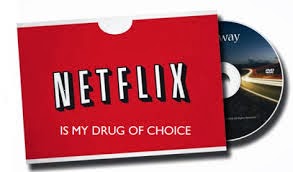
As much of this metaphor between Netflix and drugs can be found amusing by those who avidly watch TV by these means, can it become a serious problem? Felice Shapiro blogged on the Huffington Post that Netflix had "interfered with my day to day functioning...... its tentacles have woven their way into my ability to get my work done, and have affected my sleep." I think that what Mrs. Shapiro is getting at is "Netflix Streaming Syndrome." NPR praised blogger Brian Moylan of gawker.com of "creating" the disease. Symptoms include things such as insomnia, anti-social behavior, and growing impatience when you can't watch your show of choice. Huh, that sounds an awful lot like what my life has been like since it was taken over by Netflix.
It's no secret that Americans spend more time each day watching TV than citizens of other countries. And that really isn't that big of a problem to me. TV is entertaining. We like to sit and watch stories of other people after the perpetual daily story that we live for ourselves. The problem is that the ability to watch an entire series at will is actually affecting people's abilities to conduct a normal lifestyle. And if the day comes when everybody is guilty of this "Netflix Streaming Syndrome," the world will turn into a robotic society with minimal human interaction and complete incompetence from those affected. The urge to discover the resolution of a cliffhanger has proven too powerful for me, and countless others. But the only person to blame is ourselves.
Thursday, January 16, 2014
Procrastination At Its Finest

Take these blogs for example: it's an assignment for my American Studies class. Once a week we are instructed to sit down, think about the world critically, and publish it for the world to see. Doesn't seem too hard right? Well these blogs are due tomorrow. Over the past 24 hours, a plethora of blogposts have appeared from many of my classmates on my class's American Studies webpage (including myself). And as I was thinking about good material for the last hurrah of my first semester posts, I thought about what was so hard about this assignment that made it impossible to keep up.
Psychology Today stated that, "procrastinators are not born. Procrastination is learned in the family milieu." It's become like a disease in that sense. Once you catch it, you become a perpetual slacker. That may be a bit extreme, but it does become a nasty habit. James Surowiecki wrote in The New Yorker that the time you spend pushing off your work to watch your favorite shows (or any of the examples in the pie chart above) you are in fact, "actually engaging in a practice that illuminates the fluidity of human identity and the complicated relationship that humans have to time." In other words, it has become a human impulse.
I don't know if it's the thrill of living on the edge that makes us wait until the last minute, or just the overwhelming amount of other priorities we have. But I think that we value our free time to the point where we will put almost anything ahead of schoolwork until it's absolutely imperative. And I'm very interested to see what my fellow classmates are thinking, as we all stumble to the end of the fickle beast that is first semester.
Wednesday, January 15, 2014
What We Have In Store For Sochi
The Olympics may be the greatest spectacle known to man. It is a time when all citizens of humanity can stop and appreciate competition from some of the greatest athletes on the planet, all of whom are giving their all to represent their country in a way they see fit. There aren't many bad things you could say about the olympics.... Or are there?
Sochi was an interesting destination to pick from the get go. Being the "Summer capital of Russia," Sochi never before bothered to cut ski slopes into the surrounding Caucasus Mountains. Sochi has been transformed from "head to toe to soul," said Andrea Sachs in the Washington Post. But aside from that, Sochi has had its fair share of doubters given the recent events.
Several terrorist attacks near the city have left questions regarding the safety of the athletes. But no need to worry, after all, "the Olympic Games are about bringing people... together to overcome our differences in a peaceful way," according to International Olympic Committee President, Thomas Bach. Alright, you got me, that was a tad sarcastic. Two bombings and 32 dead less than 2 months in the city host to elites from most every nation in the world seems to require a response that is a bit more serious than just a reassurance and description of what the Olympics are supposed to do.
I do appreciate what Bach is saying though, because it's true. Once every 2 years the World and its people forget differences, and learn to coexist. This reality makes it very difficult to even consider postponing the games, which seemed like a halfway decent idea in December. The situation seems to be under better control now. And I have all of the confidence in the world that the Olympics will prove to be everything they are supposed to be, and most importantly, the athletes will all remain safe. But let me ask you something. What if something does happen? How will the world react? Will it turn into an "I told you so moment" where questions like, "was this the smartest thing to do" arise? Or will it just be mourned briefly and pushed aside?
Monday, January 13, 2014
How Far Does Popularity Get You In Sports?
The NBA all star game, a sports spectacle home to some of the greatest games in history. Just kidding, most of it is a laugh riot. But every person selected feels that it is a great honor to represent their team, conference, and the NBA as a whole as one of the best players of that season. But it seems more and more like the same game over and over again. Maybe it's because year in and year out, the same exact players are the most productive. Or maybe it's rigged. No I'm not talking about a conspiracy by the NBA to exclude certain players. But, rather a stubbornness by the voters, the diligent fans of the game of basketball.
Let's take a look at Kobe Bryant shall we? Most everybody who knows anything about sports is familiar with him. He's one of the greatest basketball players of all time, earns nearly hundreds of millions of dollars in endorsements each season. His production up to the age of 34 was impecable. This year, however, Bryant's production has been extremely limited due to injuries, having played in only 6 games, he is averaging 13.8 points per game. Which is 12 points lower than his career mark. Despite this, Bryant has received more votes than almost every player in the Western Conference. It's certainly not because his opponents aren't talented and worthy. In fact, in a recent interview, Bryant pleaded, "my advice would be to vote for some of these younger players," coining Portland's guard Damian Lillard several times, who is a more than deserving candidate.
There are many players who get snubbed from the all-star game, and I believe that American values plays a major role in who gets this kind of exposure. Many factors could play into this, like where the team is located. If it isn't a major market, it's more difficult to be discovered by the American public. Even salary could play a part. If you aren't even the highest paid player on your team, then how could you be one of the best players in the league? It has turned into a popularity contest. The most famous players will always find a way in, even if they are undeserving.
Sunday, December 15, 2013
Bidding Farewell to a Once in a Generation Hero

The improbable journey from prisoner to president officially came to an end on Sunday, when Mandela was laid to rest in his childhood village of Qunu. I had never really looked into his life (besides seeing the movie "Invictus") before. And with a little bit of research I found clear similarities to problems that we continue to face on this side of the pond.
President Obama made a speech at Soweto soccer stadium in South Africa where he he received a thunderous applause. He hailed Mandela's countless acts of reconciliations, noting that he was jailed for 27 years by the apartheid regime, but alas he still embraced his Afrikaner (white minority) enemies when he was released. Obama said "It took a man like Madiba (Mandela's clan name) to free not just the prisoner, but the jailer as well." This quote is very powerful in many ways, and it's something that, though overlooked, is still a problem today right here in these United States.
Mandela's death came right at the end of a unit in my American Studies class about the Prison-Industral Complex, which refers to the rapid expansion of the prison system and increase in inmate population in the United States since 1970. Law enforcement is cracking down on imprisonment for non-violent crimes, especially on those in the ethnic minorities. Mandela was in the middle of his prison term at Robben Island when this began. His life sentence was handed over due to a "civil disobedience" charge. In the United States we are seeing the enforcement of a "three strikes and you're out" system for nonviolent crimes. Where you are put away for life for things that, a few decades ago, weren't even considered a felony.
Although the United States is probably considered more "first world" than South Africa, the Number of black males in prison per 100,000 during the Apartheid era was 851. In comparison for the United States, the number is 4,848. So my question is, who will be our Madiba? When, in fact, the domestic problem is worse.
Sunday, December 1, 2013
What Will They Think of Next?

Samsung released its Galaxy s3 watch some 2 months ago, and already 800,000 units have been sold. Me being the old fashioned person I am, finds it ludicrous to even consider purchasing something like this. When one has their phone in their pocket or bag at all times (as most people do in this day and age), what possesses them spend another $300 or more on this rather than, say, A REAL WATCH. David Pogue of the New York Times, "The galaxy gear is bulky and useless. It needs a phone to be even moderately useful." The breakthrough has gotten consistently sub-par reviews similar to Pogue's since its release, and Samsung's 2013 will end on a bittersweet note. After all of the hype after surpassing Apple for the worlds largest smartphone carrier earlier in the year, Samsung has come of short of the hype they had received.
Be that as it may, this trial run will be perfected in the near future, and items like this will always be bought by Americans. It goes back to a recent discussion in my American Studies class. The United States spends more money on weapons than all of the other countries combined. The reason being, not that our old weapons were bad or dysfunctional. We could probably still blow up the whole world if we wanted to. But we always need the latest and greatest just to know that we can. It's the same thing with the every day citizen. American's value groundbreaking inventions. So I'm excited to see the release of the first car that can drive itself, when the wealthy citizens of the world can surpass every level of laziness put forth so far.
Sunday, November 24, 2013
Kennedy's Legacy

Kennedy represented a new era in leadership when he took office, he was a "youthful charmer who turned the White House into an idealistic 'Camelot,'" according to Doyle McManus of the Los Angeles Times. His increasing approval ratings seem shocking to historians. Many view him as a president who couldn't pass legislative initiatives, is blamed for the escalation of the conflict in Vietnam, and a relentless womanizer. A 1988 survey of historians named Kennedy the most overrated figure in American History, which begs the question, what did he really do in office? Americans value glamour, and when an innovator such as Kennedy and his presence comes around, he's bound to have his fair share of supporters. For the same reason that we have advertisements of the most visually appealing people that companies can find. Kennedy may have been thought of more because of his appearance (in comparison to the many men he followed, no offense to them) rather than his accomplishments. Kennedy's legacy has been embellished in my opinion, but I'd like to hear yours as well.
Sunday, November 17, 2013
Honoring or Offending Veterans?

The jerseys have received mixed reviews thus far, with many voicing that the extra red in the design (seen in between the red streaks on the helmet to the left) appears to resemble blood spatter. Under Armour, the designer of the uniforms, released a statement saying that, "the suggestion that these uniforms are depicting streaks of blood is completely false and uninformed." Instead, they are meant to feature an "authentic distressed pattern which depicts a flag that has flown proudly for a long period of time."Which seems like the more reasonable claim based on first sight? I'll go with blood.
I personally love these jerseys and the cause they are going towards. Northwestern will have absolutely no trouble selling these jerseys for big money, and making a substantial contribution to a fantastic non-profit organization. Be that as it may, it is very understandable that these jerseys can be portrayed as offensive. The pride that Americans hold for their veterans is undeniable, monuments and propaganda nation-wide honor members of the armed forces. But, sometimes we go over the top. Northwestern and Under Armour should have toned it down a bit, and I think after this attempt at honoring America's vets, franchises and teams will take a more conservative approach.
Sunday, October 27, 2013
Cyclists in the Streets

But with every positive-minded initiative comes controversy. With the enforcement of Bike 2015 Plan comes an annual cost of $25 to register bikes to the city. Citizens of Chicago are outraged by the idea that they have to "insure" their bike. I would be too. It may not seem like much, but on top of the skyrocketing tax rate in Cook County, it can really add up, especially for lower income families within the city limits.
In 2009 there were 1,484 crashes involving bicyclists. Mayor Emanuel's plan is supposed to cut that in half. Much of the city though is already equipped with bike lanes, over 100 miles in fact. Only 46 miles of bike paths will be added to Chicago's streets. I don't see that making as large a difference as the trusty politicians of the City of Chicago are anticipating.
Saturday, October 26, 2013
An Athlete's Worst Nightmare

Often referred to by the American Journal Of Sports Medicine as the "Holy Grail of Orthopedics," finding a way to repair a person's own damaged ACL. Until nearly two decades ago, a torn ACL was almost certainly a career ending injury. The gold standard since the early 1990s has been what is know as an ACL Reconstruction, which involves taking a graft from a persons tendon or muscle in another part of the body and replace the ligament all together. The reason being, the ACL is the only ligament in the knee that cannot repair itself. Dr. Martha Murray, an orthopedic surgeon at Boston Children's Hospital and Harvard Medical School, has begun to explore the inside of the knee to find a solution. It has been concluded that the ACL is coated in synovial fluid, which prevents blood from clotting, a fluid that is not present around other ligaments, more results and experiments can be seen here.

The reason for the recent push for a solution has been a violent spike in damaged knee ligaments. This summer, after two weeks of NFL training camps, 15 players had their seasons ended by an ACL reconstruction. As athletes strive to be quicker, every change of direction leaves them at risk for a ruptured ligament. Athletes have generally found success in the procedure though. Robert Griffin III (pictured right) started week one of the NFL season just 8 months after going under the knife. He has demonstrated steady improvement each week of the season, and seems to be close to the peak form that NFL fans were so accustomed to seeing. Bulls guard Derrick Rose, although only playing in the preseason so far, has seemed quicker than ever in his first 8 games and has put up staggering numbers.
Despite no advancements in an imperfect procedure, high caliber athletes such as Rose and Griffin are able to effectively revive their careers, as are athletes everywhere. Eventually science will find a better treatment option, but the fact that it has been an enigma for this long is fascinating in itself.
Tuesday, October 22, 2013
Changes in Sporting Values
Forming a franchise around specific "household name" players has been a goal for General Manager's across the sporting spectrum since the dawn of organized team sports. Every team wants the best, most impactful, and most well known players to build off of. Recently though, teams have found success from unlikely sources and it has changed the way that management systems and team owners look at possible directions to pursue. Buying runs, points, and opportunities has hurdled and surpassed the idea of buying players, and franchises who haven't caught on are being left behind in the dust. "Moneyball," a 2011 best picture nominee about the Oakland Athletics (MLB), demonstrates this idea. In 2002 the A's had a total payroll of $53 million (according to baseballreference.com), whereas the New York Yankees, who finished with an identical 103 wins, payed nearly $186 million for that season. Inversely, some teams who spend hundreds of millions of dollars on All-star type players have found little to no success in comparison to the models predicted based on their acquisition. Team management has completely changed during the past few decades, especially in baseball, and it is not necessary to spend ludicrous amounts of money on one player.
The World Series has been set earlier this week. The St. Louis Cardinals will face the Boston Red Sox. The Cardinals golden age appeared to be over (at least for the moment) after the departure of their once-in-a-generation first baseman Albert Pujols. Since then not only have they maintained their credibility in the National League, but they finished tied for the best record in the MLB with no major acquisitions. Conversely, the Los Angeles Angels of Anaheim, who along with Pujols acquired three other all-stars to add to their already lethal lineup, have drastically underachieved and haven't even been in close contention for a playoff spot. The Red Sox on the other hand cleaned house last Fall after a series of big-scale acquisitions didn't work out. They rebuilt from the bottom up and worked with what they had. The two teams fighting for baseball glory over the next couple of weeks have explicit similarities. They are built off of consistent players, only few of whom are anywhere near hall-of-fame eligibility (those who are are long beyond their prime performing years). Of course there are teams filled with superstars that have great success in their respected sports. And teams should value the presence of a possible dominant force in their leagues. But recently teams have found great success without that fire power that is so stereotypically cherished. What do you think about the direction of sports franchises? What other examples do you have to support/ the "moneyball" theory?
The World Series has been set earlier this week. The St. Louis Cardinals will face the Boston Red Sox. The Cardinals golden age appeared to be over (at least for the moment) after the departure of their once-in-a-generation first baseman Albert Pujols. Since then not only have they maintained their credibility in the National League, but they finished tied for the best record in the MLB with no major acquisitions. Conversely, the Los Angeles Angels of Anaheim, who along with Pujols acquired three other all-stars to add to their already lethal lineup, have drastically underachieved and haven't even been in close contention for a playoff spot. The Red Sox on the other hand cleaned house last Fall after a series of big-scale acquisitions didn't work out. They rebuilt from the bottom up and worked with what they had. The two teams fighting for baseball glory over the next couple of weeks have explicit similarities. They are built off of consistent players, only few of whom are anywhere near hall-of-fame eligibility (those who are are long beyond their prime performing years). Of course there are teams filled with superstars that have great success in their respected sports. And teams should value the presence of a possible dominant force in their leagues. But recently teams have found great success without that fire power that is so stereotypically cherished. What do you think about the direction of sports franchises? What other examples do you have to support/ the "moneyball" theory?
Subscribe to:
Posts (Atom)